
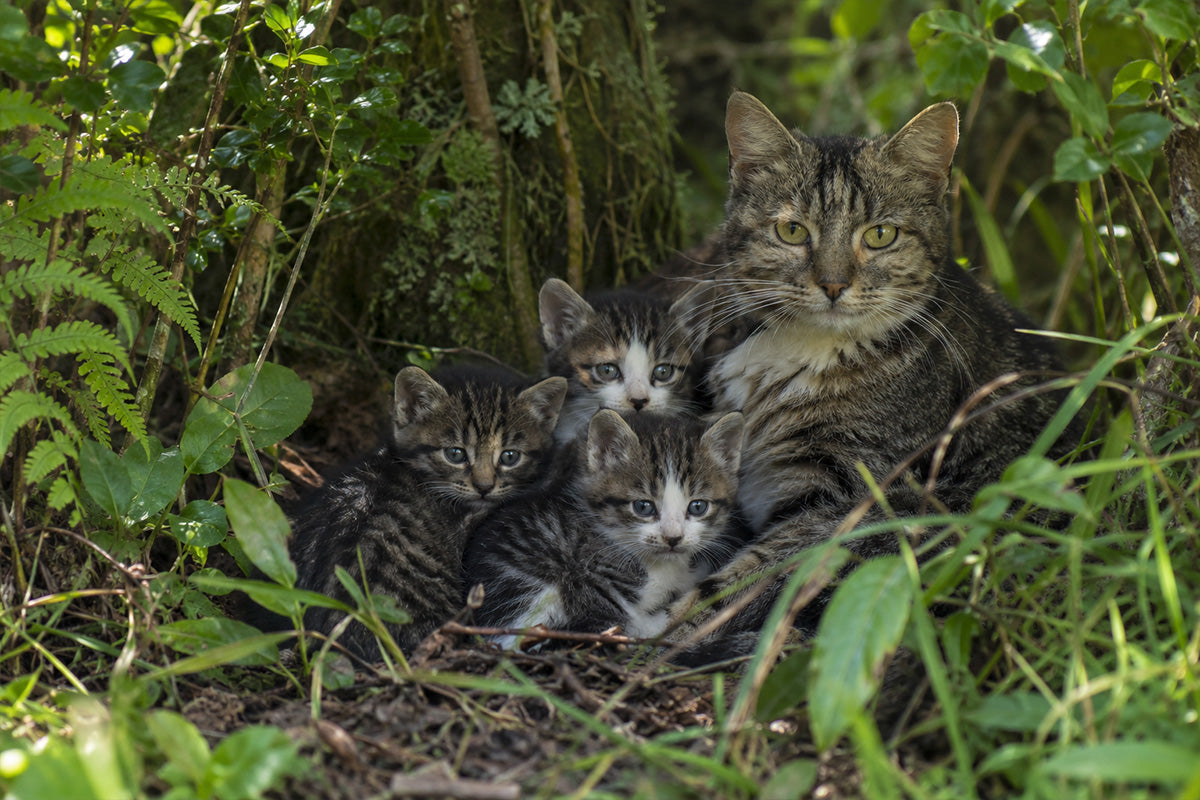
Spring and summer in New Zealand mean longer days, warmer weather, and the start of kitten season. While tiny kittens might seem harmless, feral cat populations can grow rapidly if left unmanaged. What starts as a handful of cats today can quickly become dozens tomorrow, creating a serious threat to our unique native wildlife.
The Feral Cat Population Boom
Feral cats are prolific breeders. Female cats can reach sexual maturity at just 6-9 months of age and may produce two to three litters every year, with an average of four kittens per litter.
That means a single unsterilised female can give birth to 8-12 kittens annually, and those offspring can begin breeding within months themselves. This rapid reproduction is one of the main reasons feral cat populations can explode in a relatively short period of time.
Kitten season is therefore a critical window for action. The earlier a population is controlled, the easier and more effective management becomes.
Built for Survival
Unlike pet cats, feral cats live entirely independently of humans. They are highly adaptable predators, capable of surviving in a wide range of environments from coastal dunes and farmland to alpine regions and remote forests.
They are also surprisingly mobile. Department of Conservation research tracked a feral cat in the South Island high country travelling almost six kilometres in a single night. [doc.govt.nz], [dxcprod.doc.govt.nz]
Many feral cats occupy large territories. In some areas, home ranges can exceed 200 hectares, allowing them to spread their impact across extensive areas of habitat.
A Serious Threat to Native Wildlife
New Zealand's wildlife evolved without mammalian predators. As a result, many of our native birds, reptiles, bats and invertebrates are particularly vulnerable to cats.
Feral cats prey on:
- Native birds and their eggs
- Lizards and skinks
- Bats/pekapeka
- Wētā and other large insects
- Ground-nesting and endangered species
- The impacts can be devastating. Examples recorded by the Department of Conservation include:
- A feral cat in Ohakune killing 107 native short-tailed bats in just one week. [doc.govt.nz], [dxcprod.doc.govt.nz]
- A feral cat found in Canterbury with 17 native skinks in its stomach. [doc.govt.nz], [dxcprod.doc.govt.nz]
- Feral cats contributing to the deaths of 20% of monitored kea in parts of the South Island between 2019 and 2021. [doc.govt.nz], [dxcprod.doc.govt.nz]
Why Early Action Works Best
When it comes to feral cats, waiting is rarely a good strategy.
A small population is far easier to manage than a large one. Every breeding season that passes allows more cats to establish territories, produce kittens and expand into new areas. Once populations become entrenched, control becomes much more difficult and costly.
Acting during kitten season helps to:
- Reduce future population growth
- Protect native wildlife during breeding seasons
- Prevent new colonies becoming established
- Improve the effectiveness of wider pest control programmes
- Reduce long-term control costs
In short, tackling the problem early prevents a much bigger problem later.
How Can You Get Started
Our team of experts at Traps.co.nz have pulled together a handy guide on what you need to get started, how to protect wildlife and what to do with any domestic cats accidentally caught.
Protecting What Makes New Zealand Unique
New Zealand is home to wildlife found nowhere else on Earth. From kiwi and kea to geckos, skinks and pekapeka, many of our native species have evolved in isolation and cannot withstand unchecked predation from introduced mammals.
That is why feral cats have recently been added to New Zealand's Predator Free 2050 programme as a target species for management. As kitten season begins, now is the time to act. Taking steps to manage feral cat populations today can help prevent a much larger problem tomorrow, while giving New Zealand's precious native wildlife a better chance to thrive.




Leave a comment
This site is protected by hCaptcha and the hCaptcha Privacy Policy and Terms of Service apply.